Research case · Semi-structured interview · Persona
Exploring how therapists use digital platforms
I wanted to understand how a therapist uses different digital platforms for documentation, and where those tools get in the way of the work they actually care about: their clients.
- My role
- Student researcher. Planned, conducted and analyzed the interview; built the persona.
- Method
- One 45-minute semi-structured interview with a licensed therapist, followed by affinity mapping of pain points into themes.
- Tools
- Audio recording, note-taking, transcription, affinity mapping.
- Anonymity
- All identifying information has been removed from the transcript and the persona.
- Deliverables
- Six key insights with evidence, four design opportunities, a composite persona, and a redacted full transcript.
- Why it matters
- Documentation time is time not spent with clients. Every finding points at that tradeoff.
Let the participant lead, stay on the research goal
This was my first user interview. I wrote a loose guide around three questions (what does documentation look like day to day, where does it hurt, what has changed recently), then let the therapist take the conversation where their experience was richest.
Plan
Research goal, interview guide, consent and anonymization approach. Chose a semi-structured format so unexpected topics could surface.
Interview
45 minutes, audio-recorded with notes. Open questions first, follow-ups on specifics: caseload, insurance, platforms, AI tools.
Analyze
Transcribed, pulled every pain point onto cards, affinity-mapped them into themes, then turned each theme into an insight backed by a quote.
Six things the interview made clear
Each insight is paired with the participant's own words. The through-line is that documentation is necessary, high-stakes and tedious all at once, and that the current tools make the tedious part worse.
Documentation load is high and variable
Time spent on notes scales with caseload, and the caseload changes day to day.
"Some days I may see two clients, some days I may see five… that's two clinical notes versus five. Documentation is probably the most tedious part of being a therapist."
Insurance demands increase stress
Documentation gets more rigorous and more stressful the moment insurance is involved.
"When it comes to insurance, they have a lot of rigorous documentation to pay out. That's a big challenge for a lot of therapists, including myself."
AI is emerging as a game-changer
AI-assisted platforms are already changing the workflow for some sessions.
"I even work for one platform where… the notes generate themselves because it has a program listening in the background. Those notes may have taken 20 minutes and now take five."
Documentation impacts client care
Time on notes drains the energy that would otherwise go to clients and contributes to burnout.
"As therapists, we don't want to be writing all day. We want to help our clients. Documentation takes away from that."
Accuracy and compliance are critical
Notes have to balance legal, ethical and client needs, and can be requested later.
"Documentation for a therapist is essentially covering yourself… clients may request their notes one day for legal issues, so accuracy is critical."
Current systems are frustratingly redundant
Manual, repetitive steps slow therapists down without adding anything.
"100%. It can be very redundant and tedious… a lot of manual little things you have to do on the computer."
Four places design could give time back
- 01
Simplify the workflow
Auto-generated notes with easy editing, so the therapist reviews and corrects rather than writing from scratch.
- 02
Reduce redundancy
Templates and required-field safeguards so nothing is typed twice and nothing required is missed.
- 03
Balance compliance with ease of use
Compliance is a priority for therapists, so it should be built into the flow rather than added as extra steps.
- 04
Support presence in the session
Capture key details without pulling attention away from the client in the room.
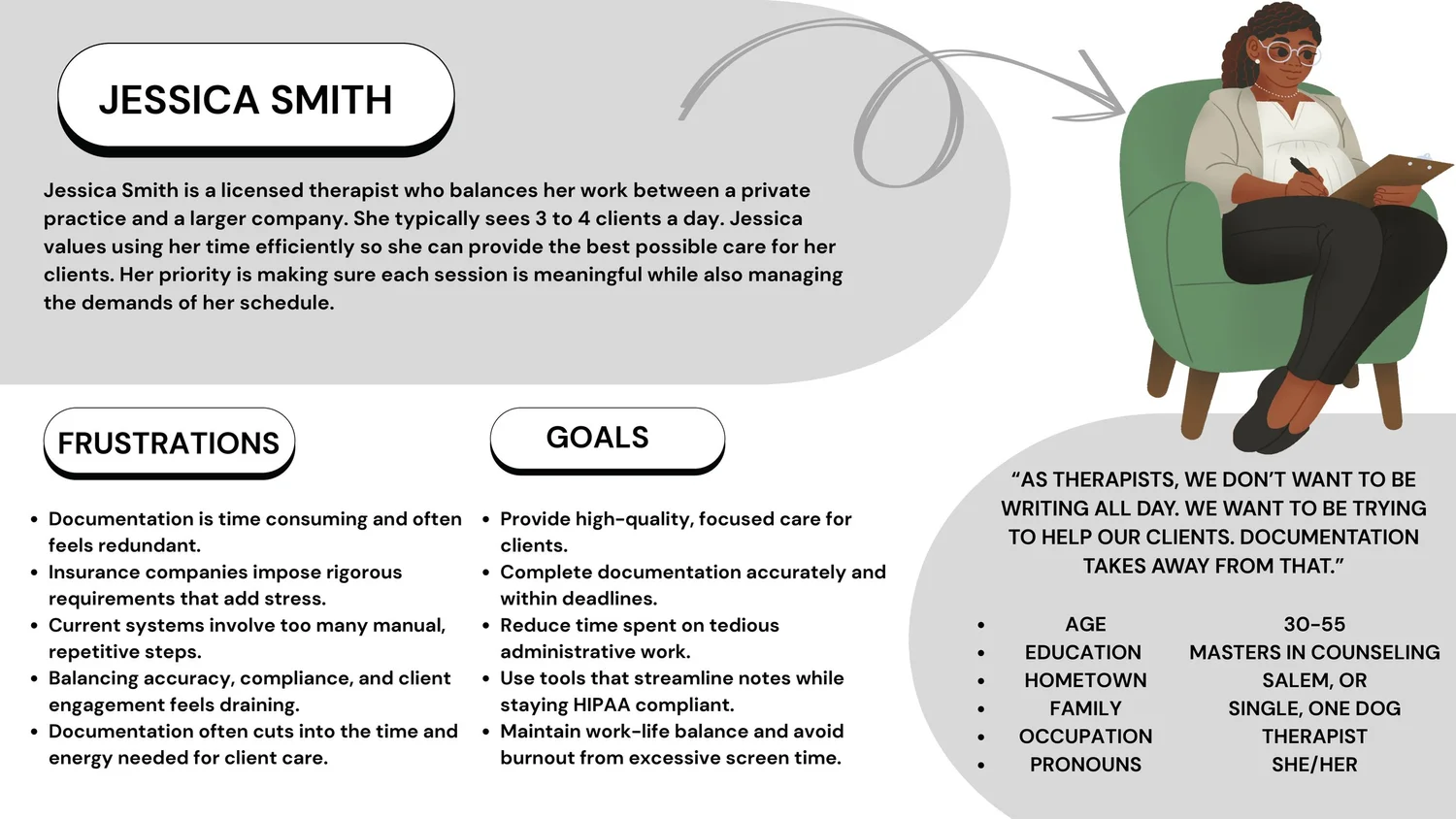
Meet Jessica
Jessica is a fictional composite persona built from the therapist interview, desk research on documentation requirements, and notes from quick usability tests of an intake flow. I affinity-mapped pain points (redundant notes, time pressure, compliance stress) into themes, then turned each theme into a goal and a representative quote. This persona guides decisions to reduce steps, clarify errors and support HIPAA-safe workflows.
What my first interview taught me
I learned how important it is to listen deeply and let participants lead the conversation while staying focused on the research goals. The most useful moments came from follow-up questions I hadn't planned.
The participant also showed me how nuanced documentation is. It isn't a form to fill; it's a judgment call made many times a day.
Let's talk
Have a research problem? I'll read every report.
Open to UX research internships and entry-level roles. Interviews, usability tests, survey design, and the patient kind of document analysis that finds what dashboards miss.