Exploring How Therapists Use
Digital Platforms
“I wanted to learn more about how a therapist uses different digital platforms for documentation, to understand the challenges a therapist faces when using various technologies.”
My Role & Method
Role: Student researcher (planned, conducted, and analyzed the interview).
Method: Semi-structured interview (45 minutes) with one licensed therapist.
Tools: Audio recording, note-taking, transcription.
Anonymity: All identifying information has been removed.
Opportunities for Design
Simplify workflows with auto-generated notes and easy editing.
Reduce redundancy using templates and required-field safeguards.
Balance compliance with ease of use, a priority for therapists.
Create tools that support presence in sessions while capturing key details.
Reflection / Learnings
This was my first user interview. I learned how important it is to listen deeply and let participants lead the conversation while staying focused on research goals.
The participant highlighted how nuanced documentation is:
“I think notes are a bit of an art… you can write far too much or way too little, and you’re always trying to find that sweet spot.”
The impact on burnout also stood out to me:
“If documentation were easier, I’d have more bandwidth for my clients. Seeing five clients plus two hours of notes is a burnout day for me.”
Key Insights
Documentation load is high and variable.
Therapists spend a significant amount of time on documentation, depending on their caseload.
“Some days I may see two clients, some days I may see five… that’s two clinical notes versus five. Documentation is probably the most tedious part of being a therapist.”
Insurance demands increase stress
Documentation is more rigorous and stressful when insurance is involved.
“When it comes to insurance, they have a lot of rigorous documentation to pay out. That’s a big challenge for a lot of therapists, including myself.”
AI is emerging as a game-changer
AI-assisted platforms are transforming workflows.
“I even work for one platform where… the notes generate themselves because it has a program listening in the background.”
“Those notes may have taken 20 minutes and now take five.”
Documentation impacts client care
Time spent on notes can drain clients' energy and contribute to burnout.
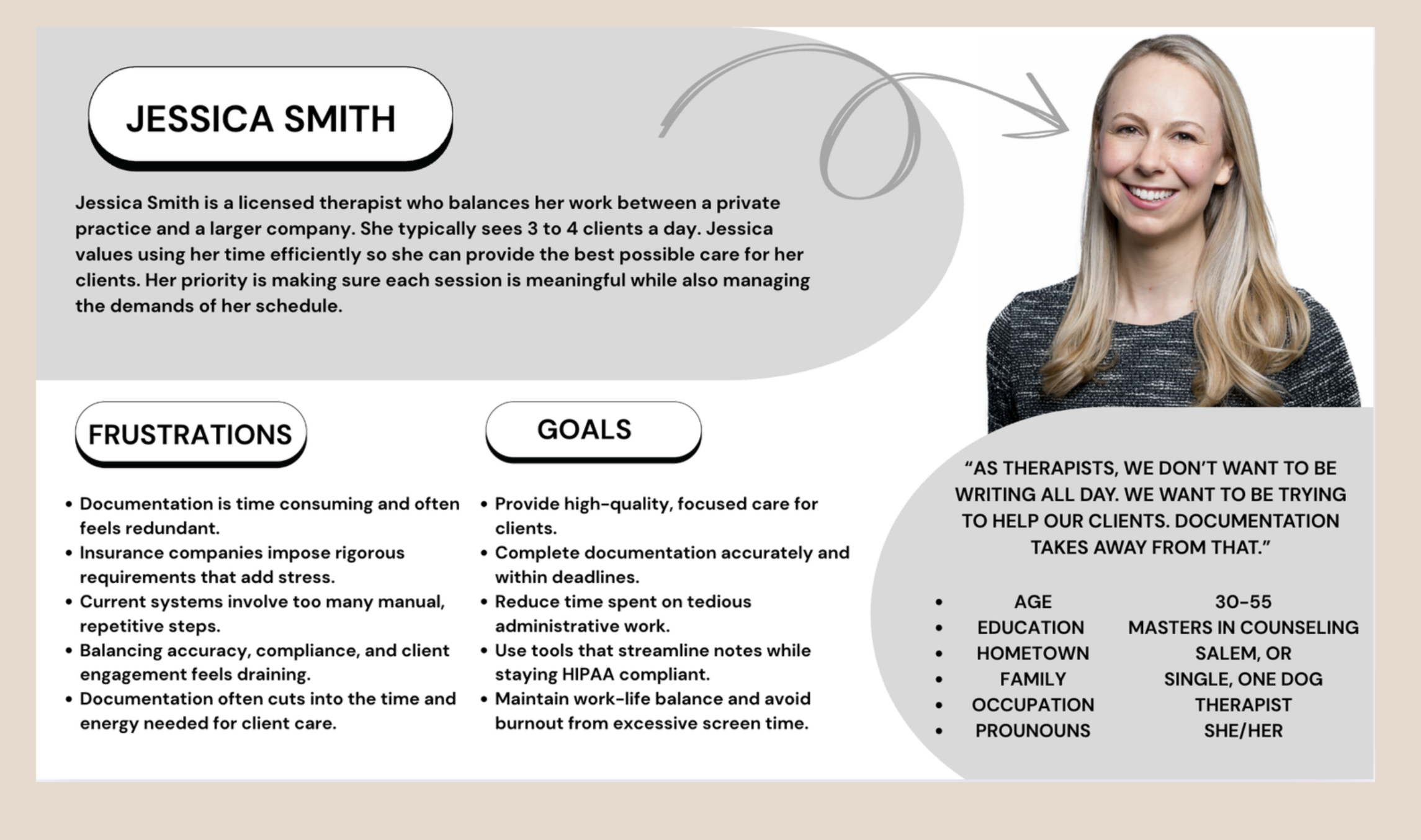
“As therapists, we don’t want to be writing all day. We want to help our clients. Documentation takes away from that.”
Accuracy and compliance are critical
Therapists must balance legal, ethical, and client needs when writing notes.
“Documentation for a therapist is essentially covering yourself… clients may request their notes one day for legal issues, so accuracy is critical.”
Current systems are frustratingly redundant
Manual, repetitive processes slow therapists down.
“100%. It can be very redundant and tedious… a lot of manual little farty things you have to do on the computer.”
UX Persona
“I created Jessica from a therapist interview, desk research on documentation requirements, and notes from quick usability tests of an intake flow. I affinity-mapped pain points (redundant notes, time pressure, compliance stress) into themes, then turned each theme into a goal and a representative quote. This persona guides decisions to reduce steps, clarify errors, and support HIPAA-safe workflows.”